The world of medical devices is a complex landscape where innovation and safety must coexist. Ensuring the safety and efficacy of these life-sustaining technologies requires robust regulatory frameworks and rigorous adherence to established standards. This exploration delves into the crucial role of medical device safety standards, examining their historical development, key international regulations, and the ongoing challenges in balancing innovation with patient well-being.
From the initial design phases to post-market surveillance, a multifaceted approach is necessary to mitigate risks and guarantee the safety of medical devices. This involves a detailed understanding of risk management principles, ethical considerations, and the continuous adaptation to emerging technologies. We will examine these aspects, providing a clear picture of the mechanisms in place to protect patients and advance medical progress responsibly.
Introduction to Medical Device Safety Standards
The safety and efficacy of medical devices are paramount to patient well-being. A robust regulatory framework governing their design, manufacture, and use has evolved significantly over time, driven by both technological advancements and tragic incidents highlighting the potential risks associated with poorly regulated devices. This framework, comprised of a complex interplay of national and international standards, aims to minimize harm and maximize the benefits of these life-saving technologies.The rationale behind stringent medical device safety standards is multifaceted.
Firstly, medical devices are often implanted or used in vulnerable patients, making the consequences of malfunction or failure potentially severe, even life-threatening. Secondly, the complexity of modern medical devices necessitates a rigorous assessment of their safety and performance characteristics to prevent unforeseen risks. Finally, maintaining public trust in medical technology is crucial; robust regulations foster confidence in the safety and efficacy of these devices, encouraging their adoption and use.
Historical Overview of Medical Device Safety Regulations
Early medical device regulation was largely reactive, responding to specific incidents or widespread concerns. For example, the thalidomide tragedy in the 1960s, which resulted in severe birth defects, highlighted the need for more comprehensive pre-market review and safety testing. Subsequently, many countries introduced legislation and regulatory bodies to oversee the medical device industry. The establishment of the U.S.
Food and Drug Administration (FDA) in 1906, although initially focused on food and drugs, marked a crucial step in this direction. The expansion of the FDA’s authority over medical devices evolved over decades, with significant milestones such as the Medical Device Amendments of 1976, which introduced a classification system based on risk levels and corresponding regulatory requirements. Internationally, organizations like ISO began to develop harmonized standards to facilitate global trade and ensure consistent levels of safety.
This ongoing evolution reflects a continuous effort to adapt regulations to keep pace with the rapid innovation in medical technology.
Key International Organizations Involved in Setting Medical Device Standards
Several key international organizations play crucial roles in establishing and maintaining medical device safety standards. The International Organization for Standardization (ISO) develops widely adopted technical standards, including those related to the design, manufacture, and quality management systems of medical devices. ISO 13485, for instance, specifies requirements for a quality management system for medical devices. The FDA, while a national regulatory body, significantly influences global standards through its guidance documents and regulatory pathways.
Other significant players include the International Electrotechnical Commission (IEC), which focuses on electrical and electronic medical devices, and regional bodies such as the European Medicines Agency (EMA) in Europe. The collaborative efforts of these organizations contribute to a more harmonized and effective global regulatory landscape for medical devices. While differences in specific regulations exist between countries, the underlying principles of safety and risk mitigation are generally consistent across these frameworks.
Post-Market Surveillance and Reporting
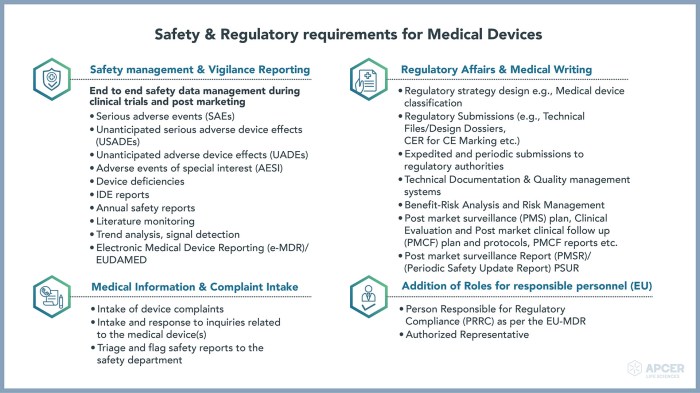
Post-market surveillance (PMS) is a critical component of medical device safety. It’s the ongoing process of monitoring a device’s performance and safety after it’s been released to the market, allowing for the identification and mitigation of potential risks that may not have been apparent during pre-market testing. This proactive approach protects patients and maintains public confidence in the safety and efficacy of medical devices.Effective post-market surveillance relies on a robust system for reporting and investigating adverse events.
This includes malfunctions, injuries, or deaths potentially linked to the use of a medical device. Manufacturers are responsible for establishing and maintaining these systems, and regulatory bodies play a vital role in overseeing the process and ensuring appropriate action is taken when necessary.
Adverse Event Reporting Procedures
Manufacturers must establish procedures for collecting and reporting adverse events related to their devices. This typically involves creating a system for receiving reports from healthcare professionals, patients, and other sources. Reports should include detailed information about the device, the event, the patient’s condition, and any potential contributing factors. These reports are then analyzed to identify patterns or trends that may indicate a safety issue.
Once an adverse event is reported, the manufacturer must conduct a thorough investigation to determine the root cause and take appropriate corrective actions. This might include issuing a field safety notice, modifying the device design, or implementing enhanced labeling. Regulatory bodies, such as the FDA in the United States or the EMA in Europe, have specific requirements for the reporting and investigation of adverse events.
Failure to comply with these regulations can result in significant penalties. For example, a failure to promptly report a serious adverse event could lead to product recalls, fines, and reputational damage.
Best Practices for Post-Market Surveillance
Manufacturers should implement several best practices to ensure effective post-market surveillance. A comprehensive PMS program should incorporate various strategies for gathering data and analyzing the information collected.
- Establish a clear and accessible reporting system for healthcare professionals and patients to report adverse events.
- Develop robust data collection and analysis methods, including the use of databases and statistical techniques to identify trends and patterns in adverse events.
- Implement a system for tracking and investigating reported adverse events, including determining root causes and implementing corrective actions.
- Regularly review and update the PMS plan based on new data and emerging safety concerns. This ensures the plan remains relevant and effective over the lifetime of the device.
- Maintain open communication with regulatory bodies and proactively share information about adverse events and corrective actions.
- Conduct periodic post-market clinical follow-up studies to assess the long-term safety and effectiveness of the device.
- Collaborate with other stakeholders, such as healthcare professionals and patient advocacy groups, to gather feedback and improve the safety of medical devices.
Following these best practices can significantly improve the effectiveness of post-market surveillance, contributing to enhanced patient safety and a more robust medical device industry.
Ultimately, medical device safety standards are not merely a set of regulations; they are a cornerstone of public health and a testament to the ongoing commitment to improving patient care. By understanding the intricacies of these standards, manufacturers, researchers, and healthcare providers can collectively contribute to a future where medical innovation is both groundbreaking and safe. The ongoing evolution of these standards, driven by technological advancements and a commitment to patient safety, ensures a continuous improvement cycle vital to the field.
Question Bank
What is the role of the FDA in medical device safety?
The FDA is responsible for regulating the safety and effectiveness of medical devices in the United States. This includes pre-market approval, post-market surveillance, and enforcement of regulations.
How often are medical device safety standards updated?
Standards are regularly updated to reflect advancements in technology and evolving understanding of safety risks. The frequency varies depending on the specific standard and regulatory body.
What happens if a medical device is found to be unsafe after it’s on the market?
Manufacturers are required to report adverse events and malfunctions. Regulatory bodies can then take actions such as issuing recalls, issuing warnings, or imposing fines.
What is the difference between ISO 13485 and ISO 14971?
ISO 13485 focuses on quality management systems for medical devices, while ISO 14971 specifically addresses risk management processes within the medical device lifecycle.